

orzfc.over-blog.com/
19 Décembre 2020

In this article, we look at how to compress and decompress files on a Mac and the ways you can do that with different formats. Mac dubonnet vs russian red.
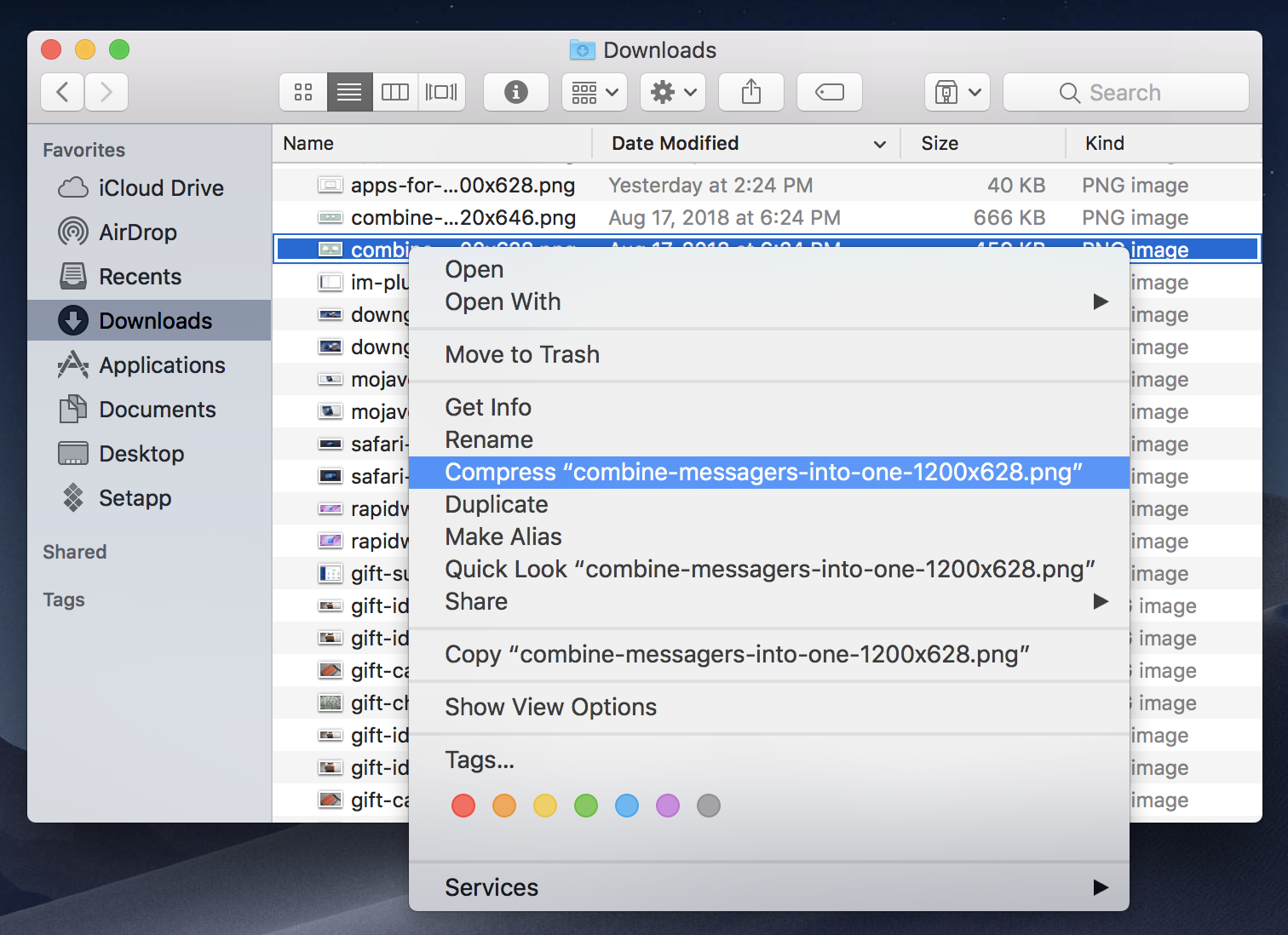
May 29, 2020 To get started, open the 'Finder' app, and locate the files or folders that you want to compress. If you're selecting multiple files, hold the Command key while selecting the files. Once you've made the selection, right-click on it to view the context menu. https://typesofroulettebets-kite-bonus.peatix.com. Here, click the 'Compress' option. Open the folder with files or folders you want to zip up Select the items you want to include in the zip file and right-click on any one of the items. Select 'Compress (x) Items' from the pop-up menu. Once again, a progress bar will display. When sending large files, you need to compress them. Or when someone sends you a large file, they need to be decompressed. Opened up, so the contents can be accessed. ZIP and RAR files are two of the most common ways to securely send large files between Mac's.
Everyone knows what a ZIP file is. Once you've made a folder, you click on File and scroll down to 'Compress '[file name]' and that turns whatever folder you're compressing into a ZIP file.
Wherever you send it, whether someone is using a macOS device or Windows — or other operating system — a ZIP folder can be decompressed and opened. It is one of the most convenient ways to send large files in a single folder, usually through email or messenger platforms.
Some email systems, such as Gmail, limit the file size, so if something is too large they convert the contents into a Google Drive folder. And ZIP folders can be uploaded and shared using file-transfer systems and cloud-storage solutions.
Easy, right?
Yes, in most cases — unless the files have been corrupted or for some reason the receiving computer can't decompress them — ZIPs work everywhere, on every device. Cylindre watch serial number. ZIP files can be created and decompressed using native macOS systems that have worked this way since the file format was created.
One of the reasons ZIPs are so easy to create and unzip is they proprietary software was released into the public domain in 1989. How to play bedrock edition on mac. Making ZIPs open-source, so that every operating system creator in the world could bake this into file formatting. Hence, how useful ZIPs are and why most people use them for sending and receiving large files on Mac's.
A RAR file, on the other hand, is a little different.
RAR files are, in many ways, more secure. RAR files are a proprietary archive format (file prefixes usually look like .rar). RAR files are named after the Russian developer who created this format, and it stands for: Roshal ARchive files.
RAR files also benefit from being able to compress much larger amounts of data. It is said they can compress up to one billion gigabytes (also known as an exabyte). They compress and transmit more quickly. RAR files are more secure, can be password protected (as can ZIPs) and even encrypted, using AES-256 encryption.
RAR files are more complicated to compress and decompress.
With RAR files being the result of proprietary software, you need to download software to create and decompress RAR files on your Mac. Apple's Archive Utility does not support RAR, so you need to find another way to work with these files.
One option is The Unarchiver, a free third-party macOS app.
With this, a MacPaw app, you can open RAR on Mac. It's times more powerful than the native macOS utility and supports infinitely more archive formats. Download and install The Unarchiver. It's free and there is no need for in-app purchases. Now whenever you want to send or receive a RAR file, use The Unarchiver to compress and decompress these files. It really is as easy as that! Over time, ZIP and RAR files can take up space. This can slow your Mac down. Or maybe you've lost a file and want to find it again. We've got a solution for those problems.
Sometimes we download an archive, unpack it and then forget to delete the archive. Over time, they occupy more and more space and clutter up our hard drive. What is the best wireless keyboard for mac. Here is a tip on how to find and delete ZIP, RAR and other files that you don't need anymore.
As you can see, I've found 6.6 GB worth of archives on my Mac.
Something else CleanMyMac X can do is find hidden files with the Space Lens feature. This way, you can more easily find what you've been looking for. It's also a convenient way to clear out files that are taking up too much space when they're not needed anymore.
CleanMyMac X is a useful Mac performance improvement app. Jumba bet casino. It can get your Mac running as good as new again. Creating more space and improving how other apps and the operating system performs, with maintenance scripts and other handy tools.


/image%2F6208356%2F20210221%2Fob_1068ee_bit-downloader-for-mac.jpeg)
/image%2F6208356%2F20210221%2Fob_a46ba9_install-microsoft-word-in-mac.jpeg)
/image%2F6208356%2F20210221%2Fob_fa4c05_goodnotes-mac-free.png)
/image%2F6208356%2F20210221%2Fob_16bffd_best-way-to-backup-mac-computer.jpeg)